Hooks and angles: how to find the ones that scale
Where scalable angles come from, the hook patterns that keep showing up in long-running ads, and how to test them without fooling yourself.
On this page
- Angle, hook and format are different jobs
- Where scalable angles come from
- 10 angles that keep scaling in ecom
- 20 hook patterns from long-running ads
- The first three seconds have three layers
- What stops the scroll isn’t what sells
- How to test hooks without fooling yourself
- How to scale an angle once it works
Most advice about hooks is a list of opening lines. Lines matter, but they’re the last decision, not the first. An ad scales because of its angle: the reason to buy it argues. The hook only earns it the next few seconds.
This matters more on Meta now than it used to. The ad system leans on your creative to find the right people, and it treats near-identical ads as one idea. Five versions of the same angle reach roughly the same people. Five different angles reach five different groups. So the work is finding angles that scale, then giving each one hooks worth stopping for.
The short version
- A new angle is a new concept. A new hook is a new version. Test them differently.
- The best angles are already in your reviews, your support inbox and your competitors’ longest-running ads.
- The hook that stops the most thumbs is often not the one that sells. Judge openings on cost per purchase.
- Don’t trust hook tests inside one ad set. Meta picks a favourite early, and it’s often the wrong one.
Angle, hook and format are different jobs
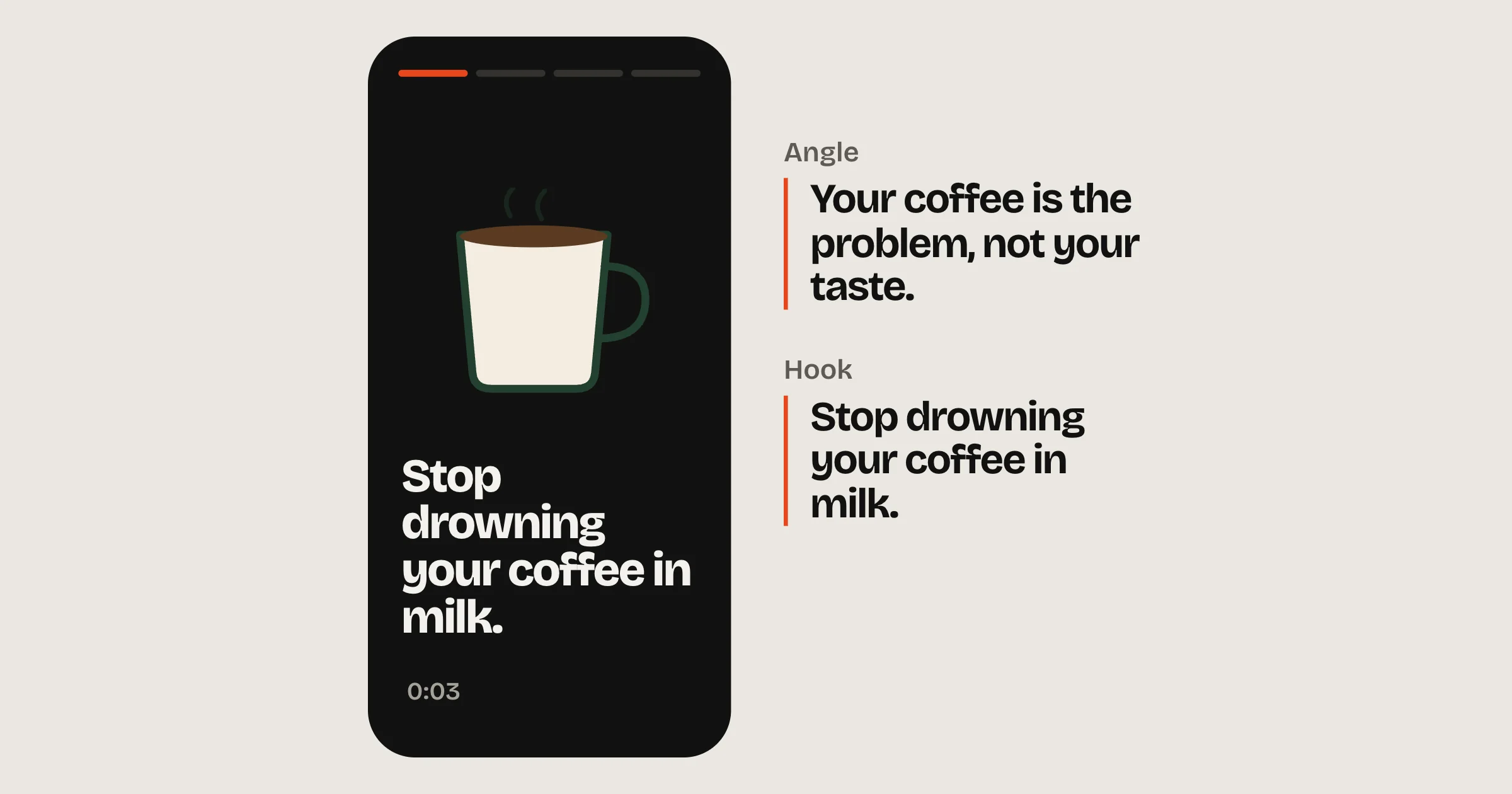
The angle is the argument: why this person should buy this product now. The hook is the first one to three seconds: the frame, line or sound that earns attention for the argument. The format is the container: a static, a founder to camera, a creator video, a carousel.
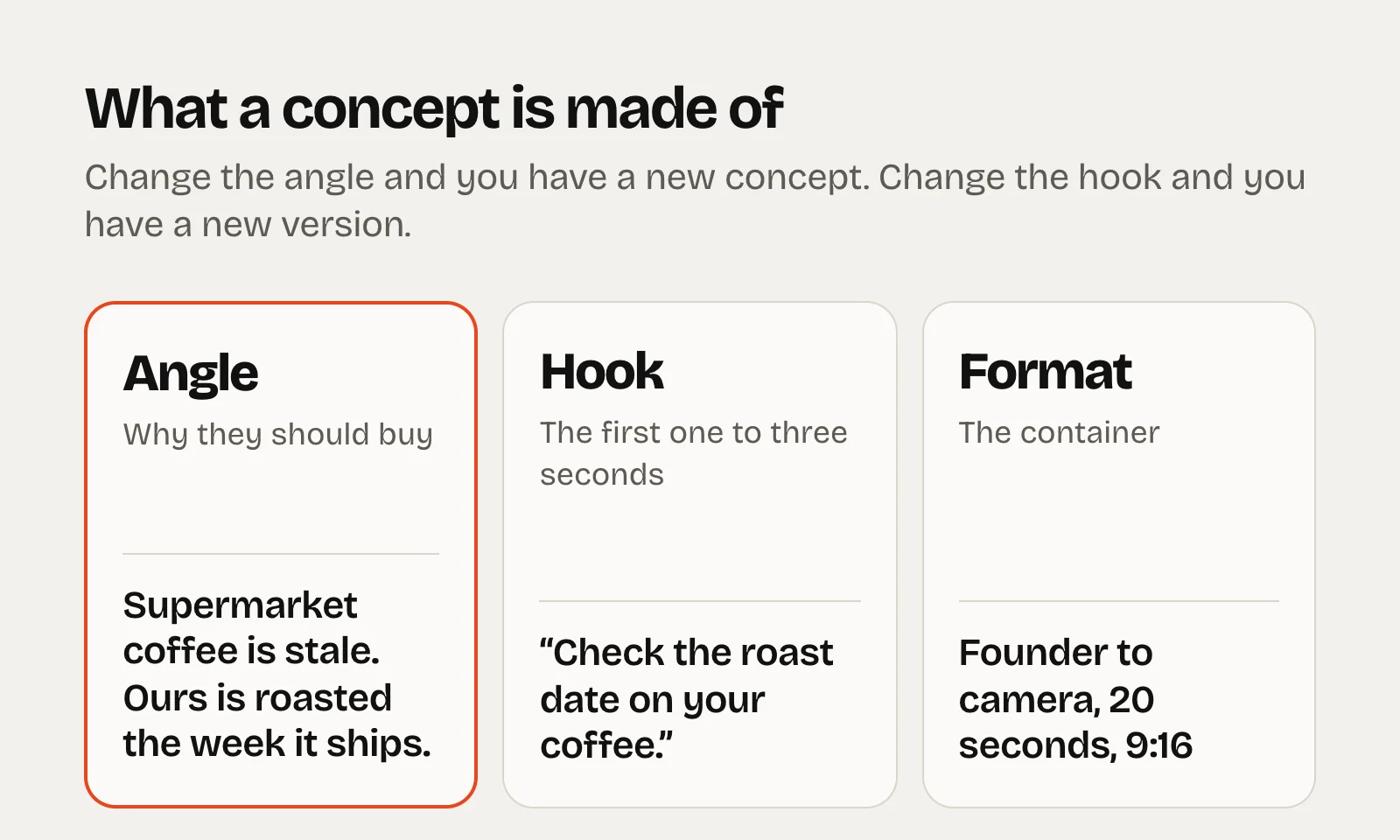
Keep them apart when you plan and when you test. Change the angle and you have a new concept that can find new buyers. Change the hook on a working concept and you have a new version of something that already sells, which is the cheapest new creative you can make.
Where scalable angles come from
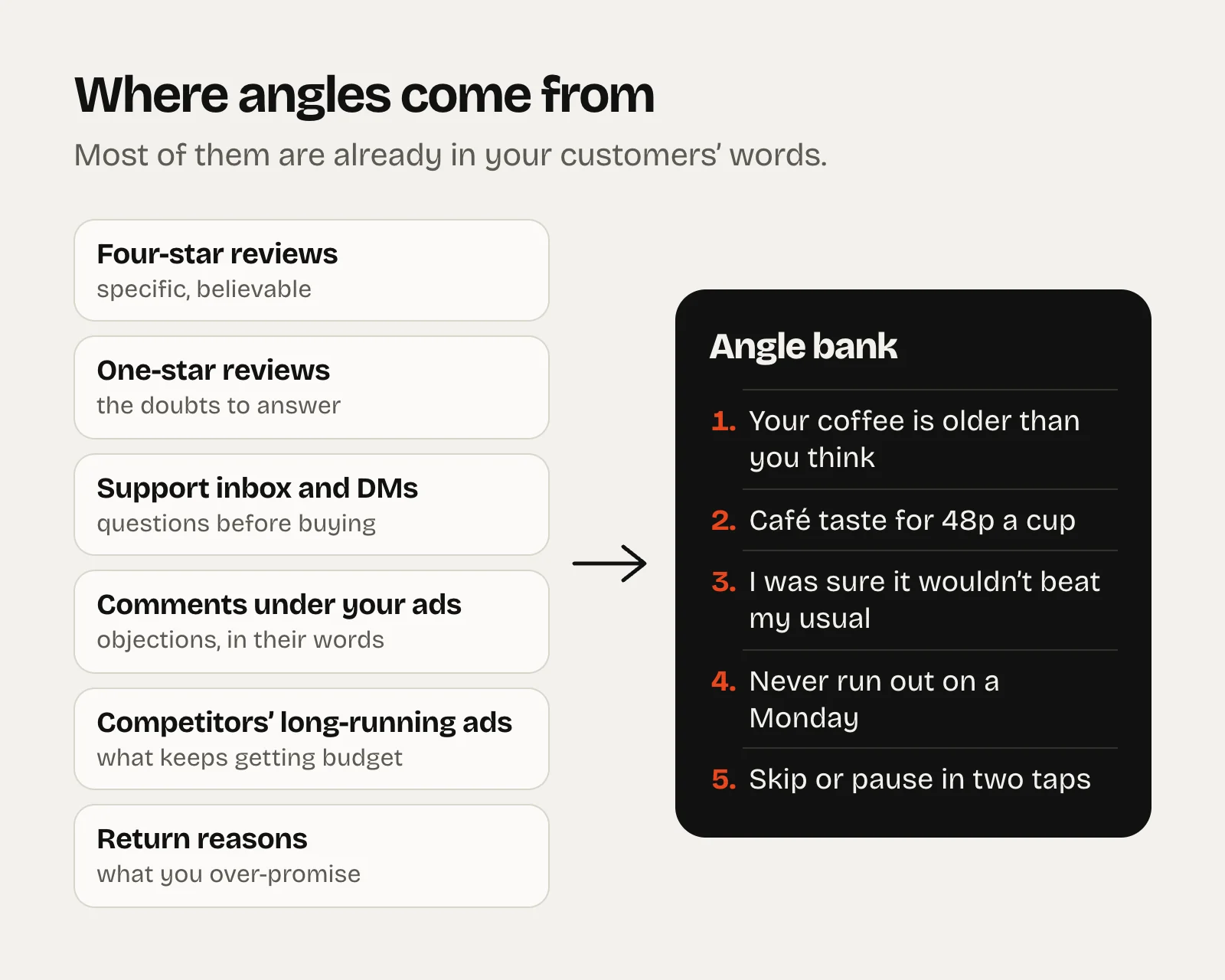
Good angles are rarely invented in a meeting. They’re found, usually in places the brand already owns:
- Four-star reviews. Specific and believable, with the detail that made the difference.
- One-star reviews. The doubts you need to answer before anyone buys.
- Support emails and DMs. The questions people ask before they order.
- Comments under your ads. Objections, in exactly the words other people are thinking.
- Return reasons. Where your current ads over-promise.
- Competitors’ long-running ads. What someone else keeps paying for.
Reading competitors in the Ad Library
The Meta Ad Library shows every active ad and the date it started running. Nobody keeps paying for an ad that loses money for months, so long-running ads are the closest thing you’ll get to a competitor’s winners list.
- Search the brand, filter to your country and to active ads.
- Look for ads that started two or more months ago and are still running.
- Write down the angle, not the execution. “Cheaper than the café” is useful. “Green background, bag on the left” isn’t.
- Count how many variations of each angle they’re running. If a brand has made twenty versions of one idea, that idea is paying.
Two things we learned doing exactly this for these articles. The Ad Library can’t sort oldest first, but if you show only active ads and set the impressions date filter to end a few months ago, you’re left with the ads that started before that date. And the start date belongs to the ad, not the idea: “2 ads use this creative and text” means it’s been duplicated, and a relaunch resets the date. When we checked 31 well-known UK DTC brands, fewer than half had any ad still running after four months, so the ones that have are worth studying closely.
10 angles that keep scaling in ecom
Most winning angles are a version of one of these. Examples are for a coffee subscription.
- The pain: the problem in the buyer’s words. “Coffee you have to drown in milk to drink.”
- The outcome: what life looks like after. “A morning coffee you actually look forward to.”
- The identity: who it’s for. “For people who notice when coffee’s stale.”
- The enemy: what you’re better than. “Supermarket beans roasted months ago.”
- The mechanism: why it works. “Roasted the week it ships, so the flavour is still there.”
- The proof: someone else’s result. “Three months in, I haven’t been back to the café.”
- The maths: the price, reframed. “Café taste for 48p a cup.”
- The objection: the doubt, answered. “Hate it? Your first bag’s on us.”
- The story: why the brand exists. “We started roasting because we were sick of stale coffee.”
- The moment: a time or season. “The Monday you don’t run out.”
A healthy account has at least three of these running at once, each as its own concept. Our audit checklist asks for exactly that.
20 hook patterns from long-running ads
These are the openings that kept showing up in the long-running ads we found. The most common were call-out questions and lines that name an enemy: a diet, a habit, a bulkier product. The examples are ours, written for a coffee brand, so you can see the pattern rather than copy someone else’s line.
Call out the reader
- The qualifier: “If you drink more than two coffees a day, read this.”
- The call-out question: “Three coffees in and still tired?”
- The self-check: “Check the roast date on your coffee.”
Name the enemy
- The status quo: “Most coffee is roasted months before you drink it.”
- The myth: “Dark roast doesn’t mean stronger.”
- The mistake: “Stop keeping your coffee in the fridge.”
Make them curious
- The insider: “What coffee shops don’t tell you about their beans.”
- Nobody warns you: “Nobody tells you coffee goes stale.”
- The question: “Why does café coffee taste better than yours?”
Lead with proof
- The result first: “Three months, zero café runs.”
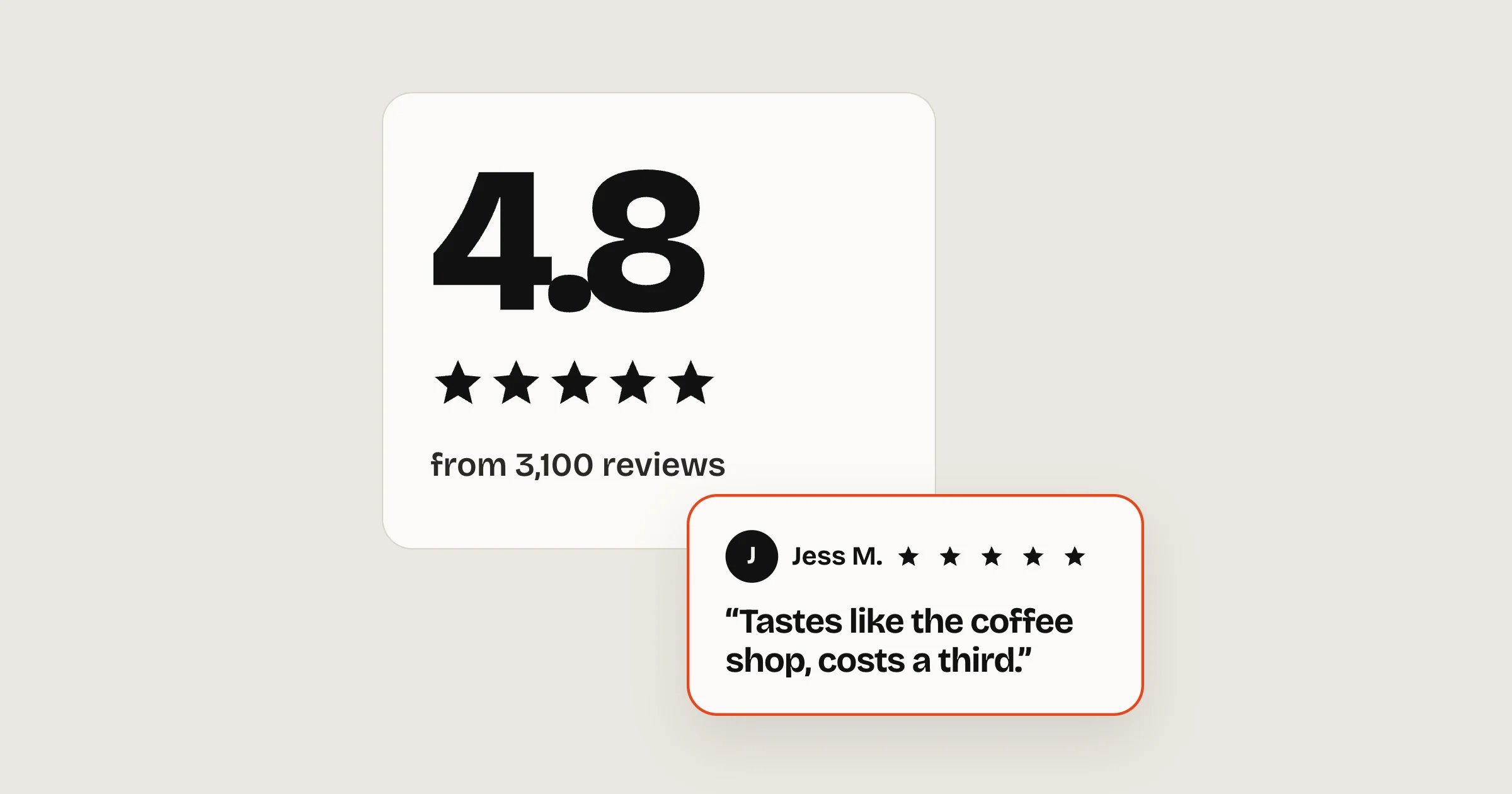
- The review read-out: a real review, word for word, as the opening line.
- The number: “41,000 people start their morning with this.”
- The reaction: the first sip, on camera, with no voiceover.
- Then and now: the same morning, before and after.
Lead with the deal
- The price reframe: “48p a cup.”
- The offer first: “Your first bag is half price.”
- The guarantee first: “Love the first bag or it’s free.”
Look like content
- The creator’s order: “This is my coffee order. What’s yours?”
- The meme caption: “Me pretending the office coffee is fine.”
- The point of view caption: “POV: you finally stopped drowning your coffee in milk.”
The first three seconds have three layers
A video hook isn’t just the opening line. It’s what people see, what they read and what they hear, and the three should make the same point. Plenty of people watch without sound, so the first frame and the on-screen text have to work alone. The voice should land the same idea for people who are listening.
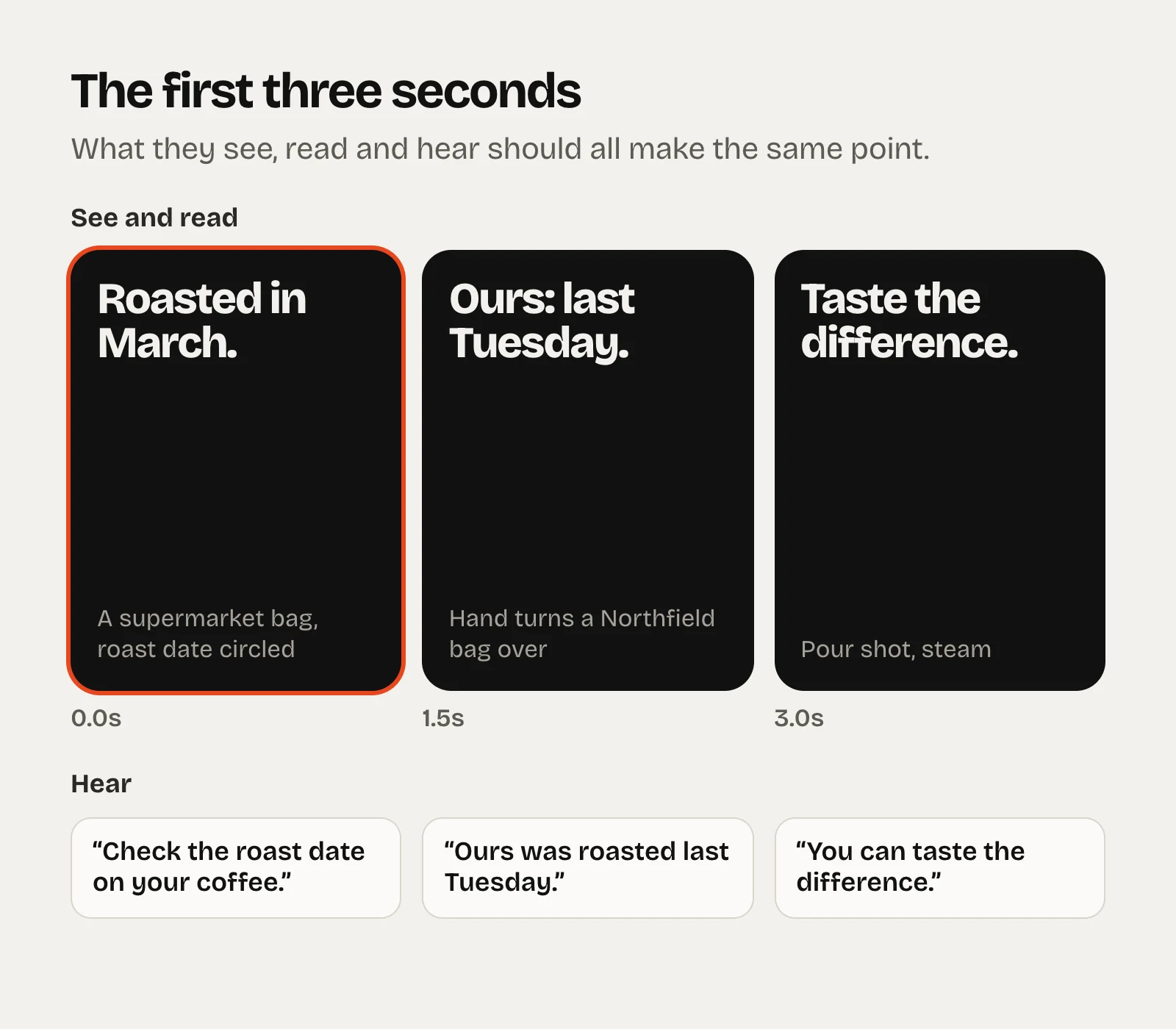
The most common failure we see: a strong line over a weak first frame, usually a logo, a slow pan or a person saying hello. Cut straight to the most interesting thing in the video.
What stops the scroll isn’t what sells
Here’s the part most hook advice skips. In a pet supplements account we run, we compared every video by the type of opening it used:
- Problem and fear openings had the highest hook rates and some of the lowest conversion. They stop people who recognise the fear, not necessarily people ready to buy.
- Myth-busting questions earned great hook rates and click-through rates, and only average sales.
- Stat or offer-first openings had weak hook rates and still beat the account average on return. The people who stayed were buyers.
- Testimonials showing a reaction converted the most clicks into orders.
- Explainer and animated openings underperformed on almost everything.
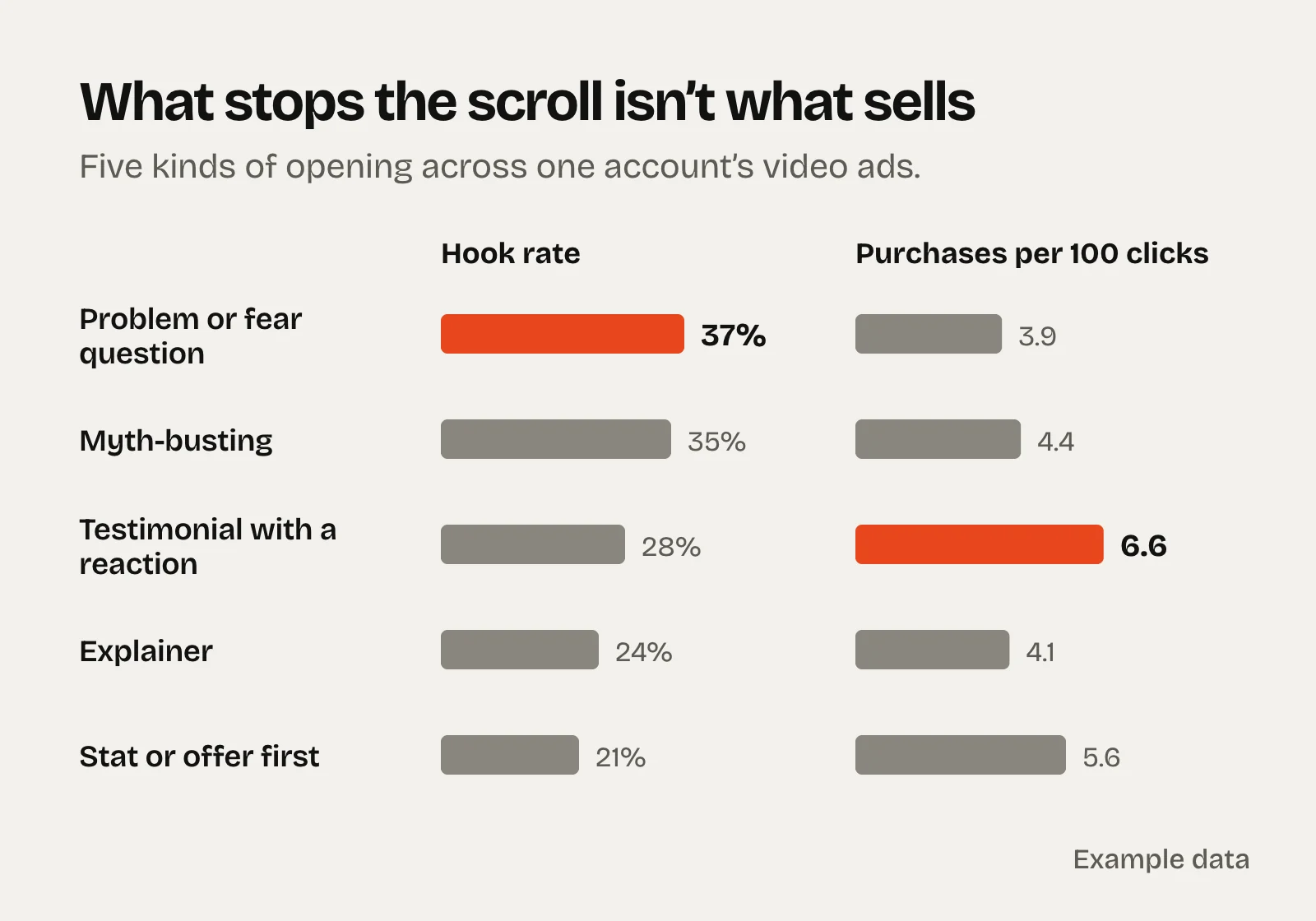
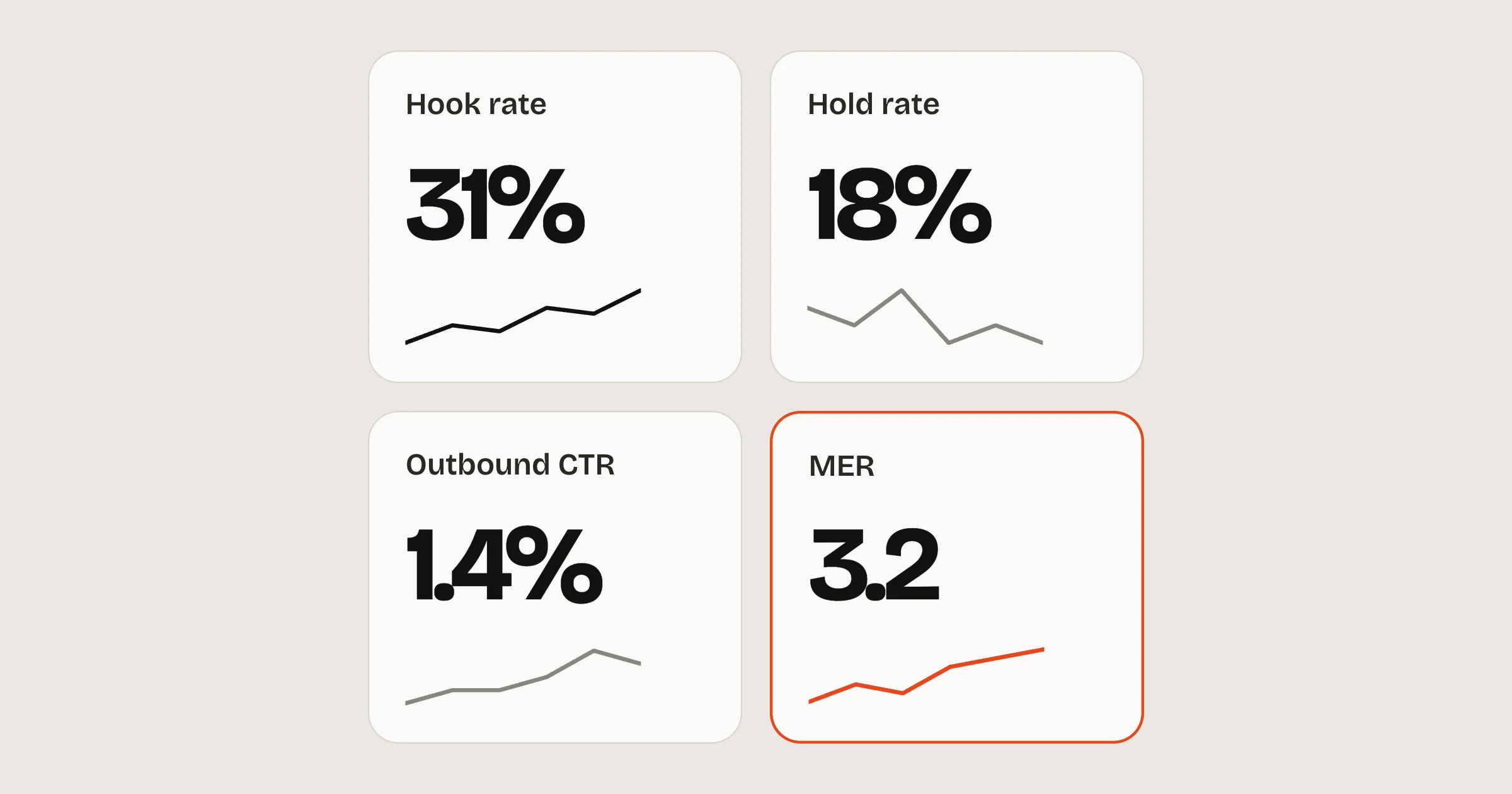
So use hook rate to compare openings on the same video, and judge the ad on cost per purchase once it has 20 or more purchases behind it. More on reading those numbers in the Meta ads metrics that tell you if an ad is working.
How to test hooks without fooling yourself
The usual hook test is three or four versions of the same video, differing only in the opening, in one ad set. It looks scientific. It usually isn’t.
Meta decides early which ad to favour and gives it most of the budget. In one account we looked at, Meta put around nine in ten pounds behind a single hook in each split, and that hook was the best performer less than half the time. The others never got enough spend to prove anything.
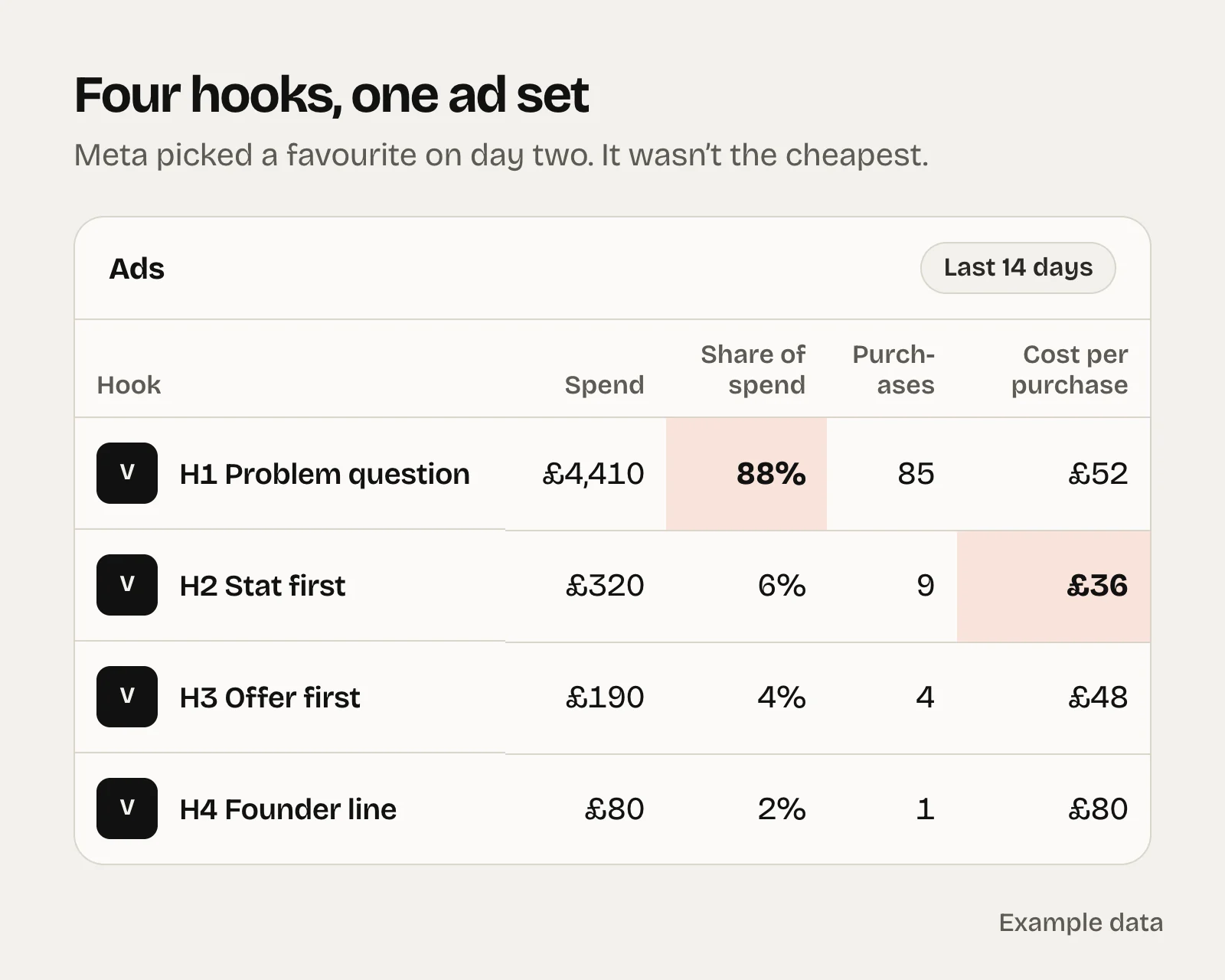
What we do instead:
- Test angles as separate concepts, each with its own ad and enough budget to reach 20 or more purchases.
- Test hooks on a body that already works. Cut three new openings onto your best video and give each one a fair share.
- Rescue the underfunded. When a hook shows a good cost per purchase on a small amount of spend, relaunch it as its own ad with its own budget. A good result on a small budget is a lead, not a winner.
- Write the decision rule first. How much spend, how many purchases, and which number decides it.
How to scale an angle once it works
A winning angle is worth more than a winning ad. Once one works, move it across formats before you look for the next idea: a static version, a founder version, a creator version, a carousel. Each format reaches people the others don’t.
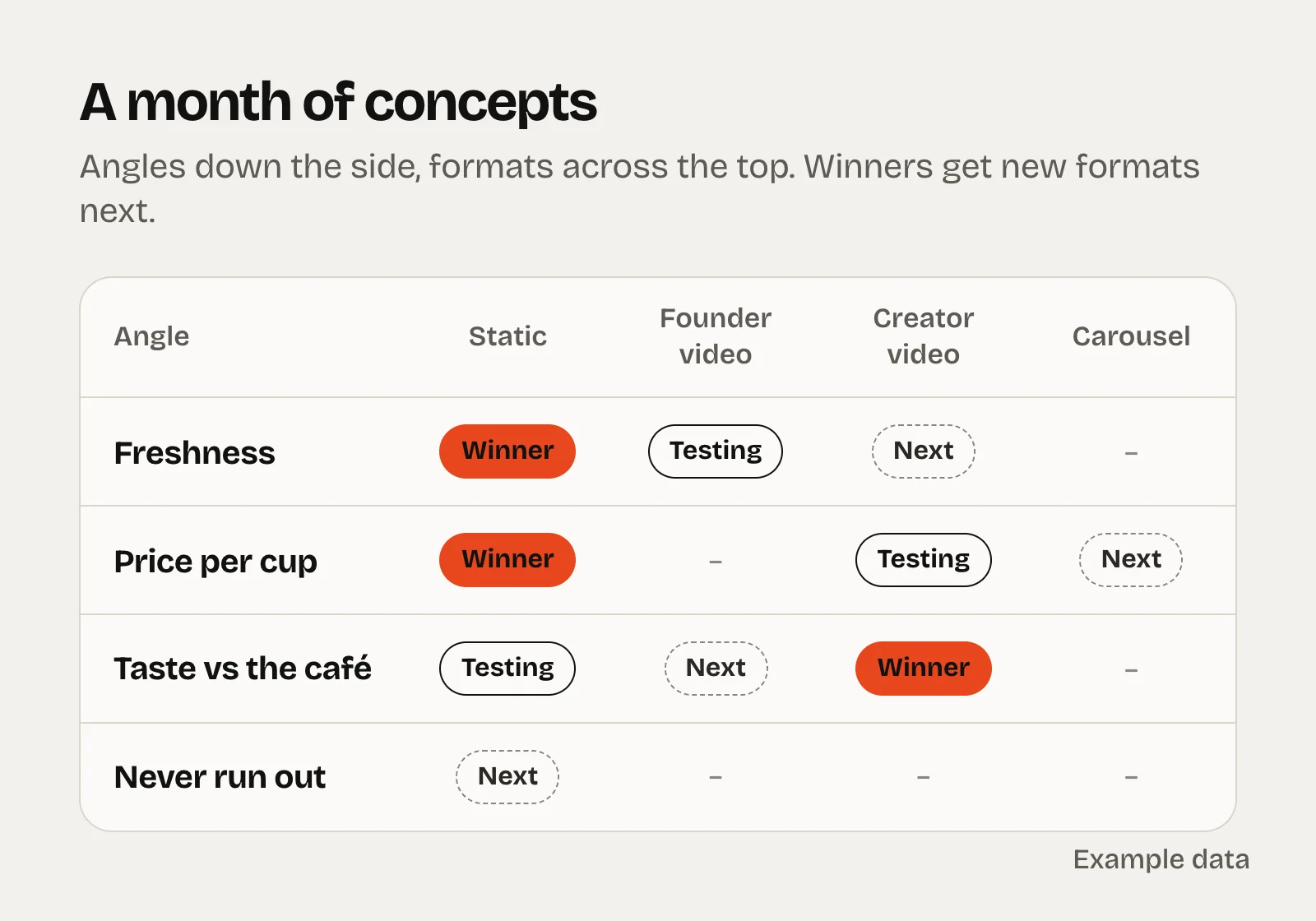
When it starts to tire, change the opening first and the body last. In our accounts, roughly one new concept in five beats the account average, and fewer hold up at real spend. That’s why the ones that do deserve every format you can give them. For layouts that work as statics, see 12 static ad formats that keep winning.