Testimonial ads that sell: how to collect, choose and format them
Most testimonial ads fail because they say the product is great. The ones that sell answer the doubt that stops the next person buying.
On this page
- 1. Start with the reviews you already have
- 2. Ask better questions, at the right moment
- 3. Look where customers already talk
- 4. Treat creators and customers differently
- 5. Choose by doubt, not by stars
- 6. Specific beats glowing
- 7. The converted sceptic is the strongest story
- 8. Match the speaker to the buyer
- 9. The review card static
- 10. Plain text can beat polished
- 11. Video testimonials in four beats
- 12. Put the right one next to the button
- Keep a testimonial bank
Every brand has testimonials, and most of them say some version of “love it”. That’s nice to read and does almost nothing in an ad. The person scrolling past isn’t wondering whether your customers are happy. They’re wondering whether it’ll work for them, whether it’s worth the money, and whether they’ll regret it.
A testimonial sells when it answers one of those doubts in a real customer’s words. This is how we find those testimonials, pick the ones worth running, and turn them into ads and product page sections.
The short version
- Mine the reviews you already have before you ask for new ones. Three- and four-star reviews are often the most useful.
- Tag every review by the doubt it answers, and build ads around doubts, not star ratings.
- Specific beats glowing: a number, a timeframe or a clear before.
- Keep the original review and the customer’s permission on file, and never change what they meant.
1. Start with the reviews you already have
Export every review you’ve got, from your store, your review app and your marketplace listings. Then read them properly, in this order:
- Four-star reviews first. They’re specific and believable, because the customer has thought about what wasn’t perfect.
- One- and two-star reviews next. They’re a list of the doubts your ads need to answer.
- Five-star reviews last. Pull the ones with a detail in them. Skip the ones that only say “great”.
Give each useful review three tags: the doubt it answers, the detail that makes it believable, and where it should go: an ad hook, a static, the product page or an FAQ.
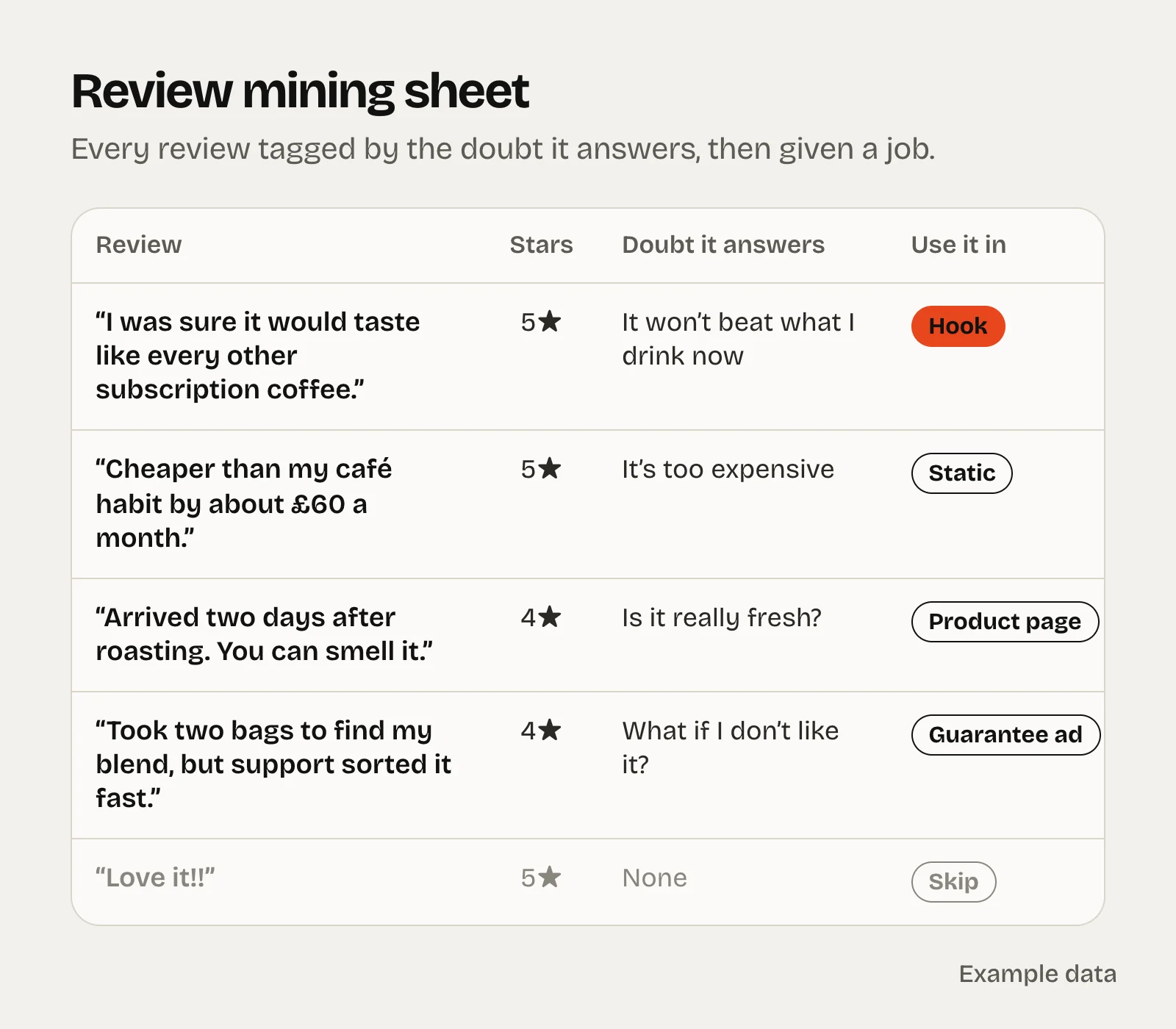
A few hours with a good sheet like this usually gives you more ad ideas than a month of brainstorming, because the angles are already in your customers’ words.
2. Ask better questions, at the right moment
Most review requests go out the day after delivery and ask for a star rating. That gets you ratings. To get usable testimonials, ask after the customer has had the result, and ask questions that pull out stories.
Timing depends on the product. A coffee subscription might ask after the second bag, a supplement after 30 to 60 days, clothing after the first wash. The questions that work best for us:
- What nearly stopped you ordering?
- What was different from what you expected?
- What would you tell a friend who’s on the fence?
- What were you using before?
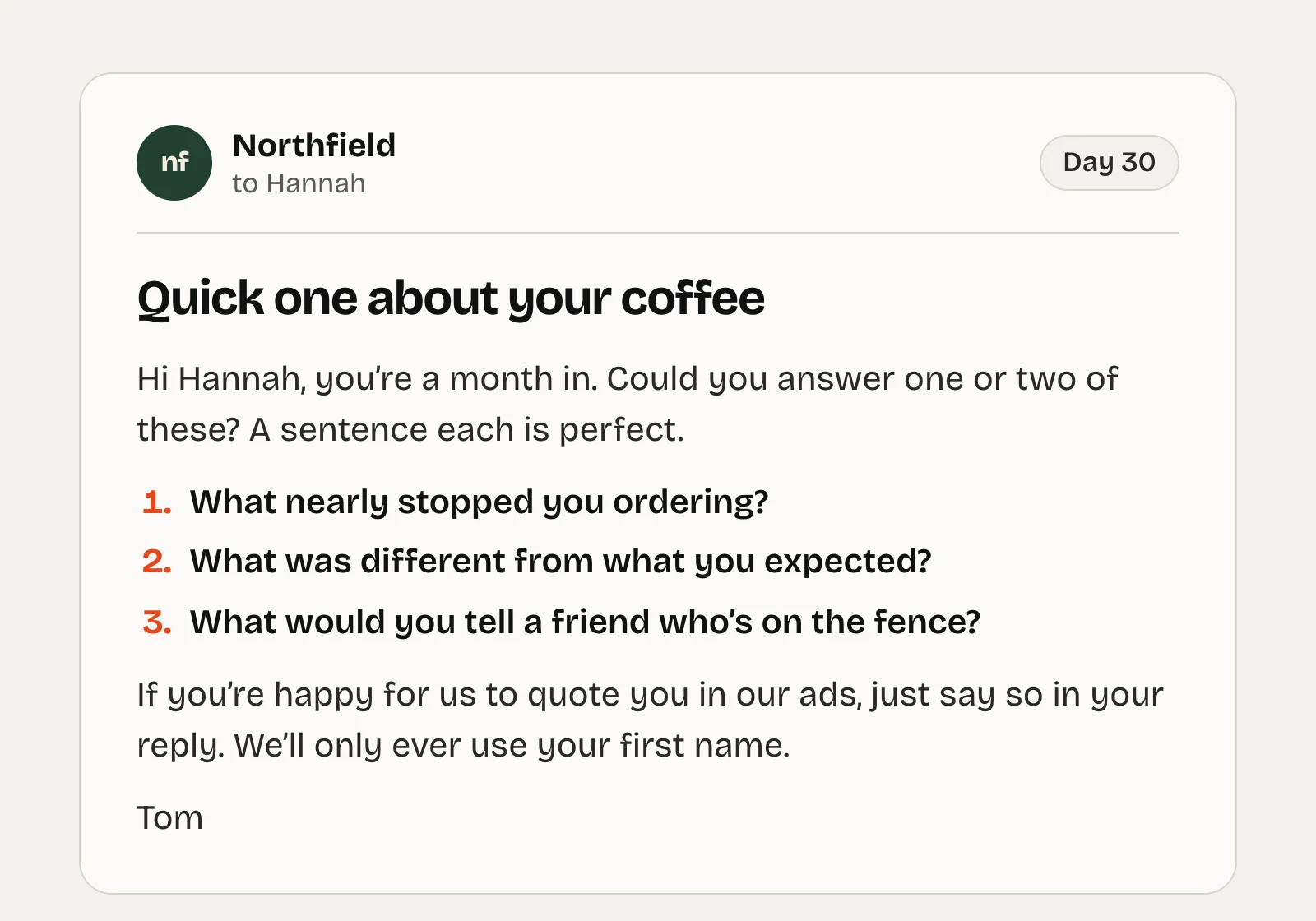
The first question is the most valuable one you can ask. The answer is the objection, and the rest of their reply is how it got answered.
3. Look where customers already talk
Customer service emails, DMs, comments under your ads and post-purchase surveys are full of unprompted, specific language. “I was worried it’d be too strong” is a better hook than anything a copywriter would write, because it’s exactly what the next buyer is thinking.
If you want to use someone’s words in an ad, ask them first, and keep the reply.
4. Treat creators and customers differently
Creator content is a performance of a testimonial. Customer testimonials are evidence. Both have a place, but they do different jobs. Creators are good at delivering a real customer story on camera. They shouldn’t be presented as customers if they aren’t.
The rules have tightened on both sides of the Atlantic. In the UK, fake and undisclosed paid reviews have been banned under consumer law since April 2025, and the advertising code already expected testimonials to be genuine, held on file and used with permission. In the US, the FTC’s rule on fake reviews and testimonials has applied since October 2024. The practical version is simple: keep the original review, get written permission, and don’t edit a quote until it means something the customer didn’t say.
5. Choose by doubt, not by stars
Before you pick a single testimonial, write down the five doubts that stop people buying. Your one-star reviews, your support inbox and the questions people ask before ordering will give you the list. For a coffee subscription it might be:
- It won’t taste better than what I drink now.
- It’s too expensive.
- I’ll end up with bags I don’t want.
- Subscriptions are a pain to cancel.
- Is it actually fresh?
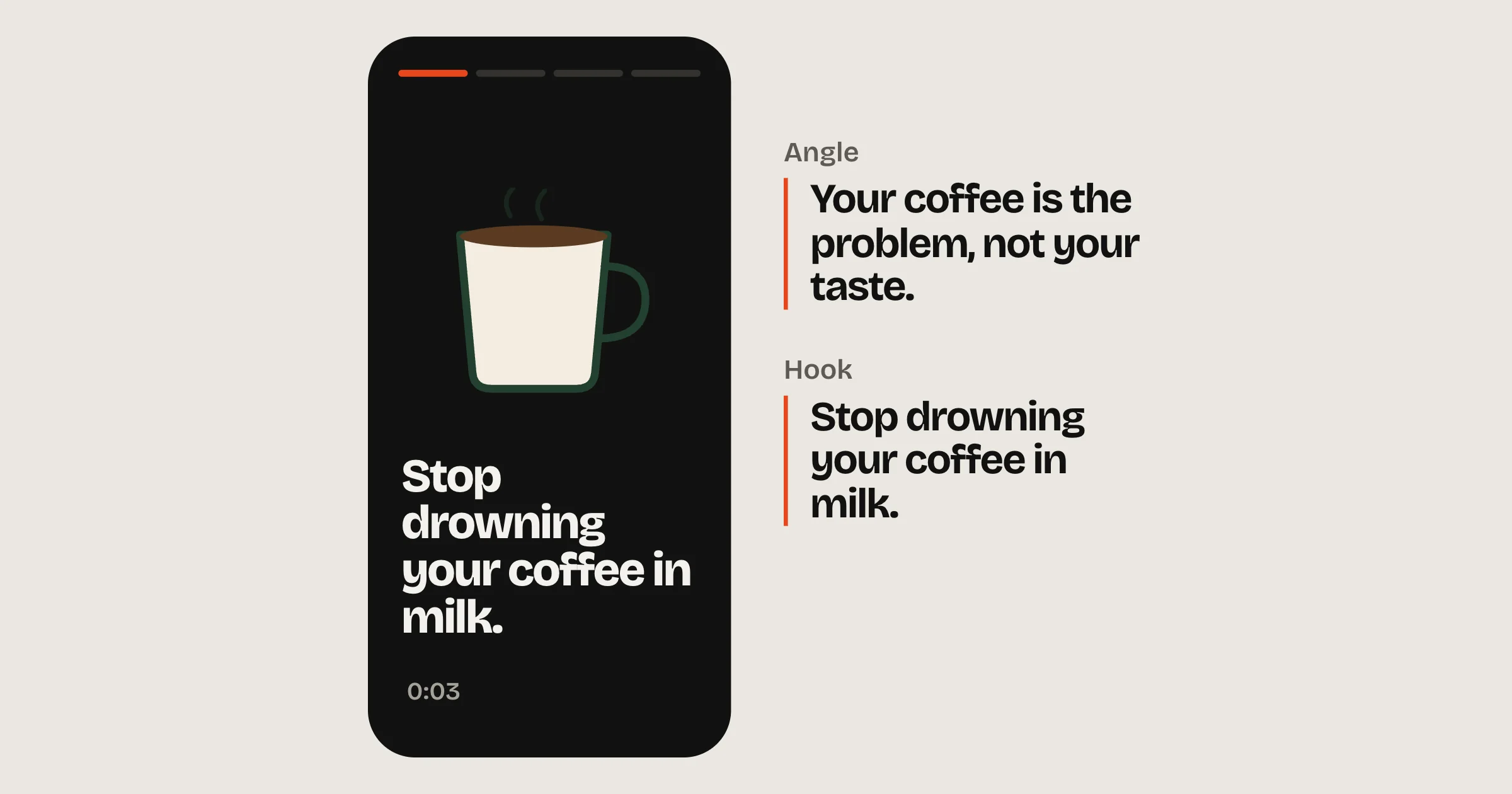
Then pick one testimonial for each doubt and make one ad per doubt. That gives you five genuinely different ads, which matters because Meta treats near-identical ads as one idea. We cover that in hooks and angles.
6. Specific beats glowing
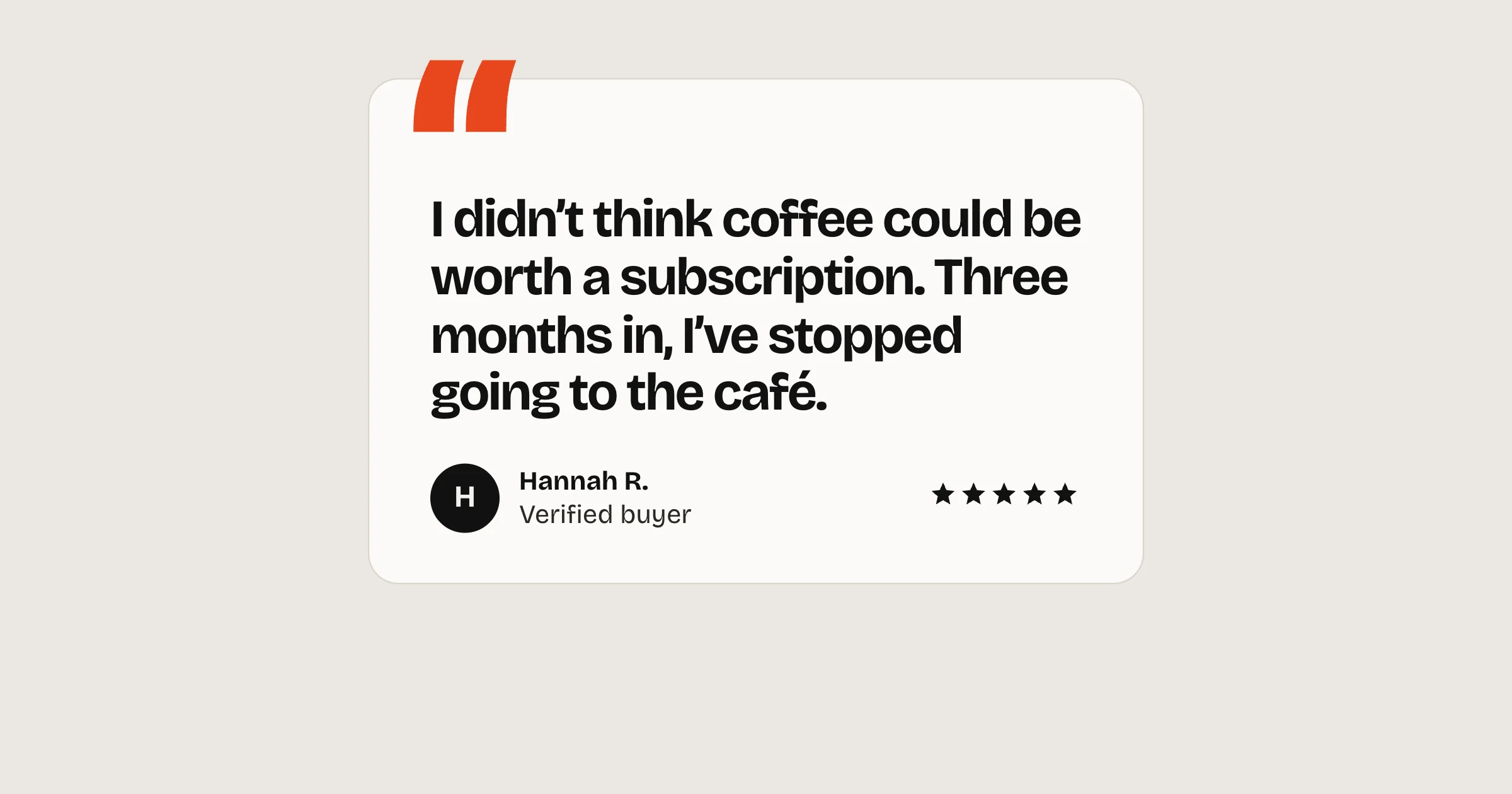
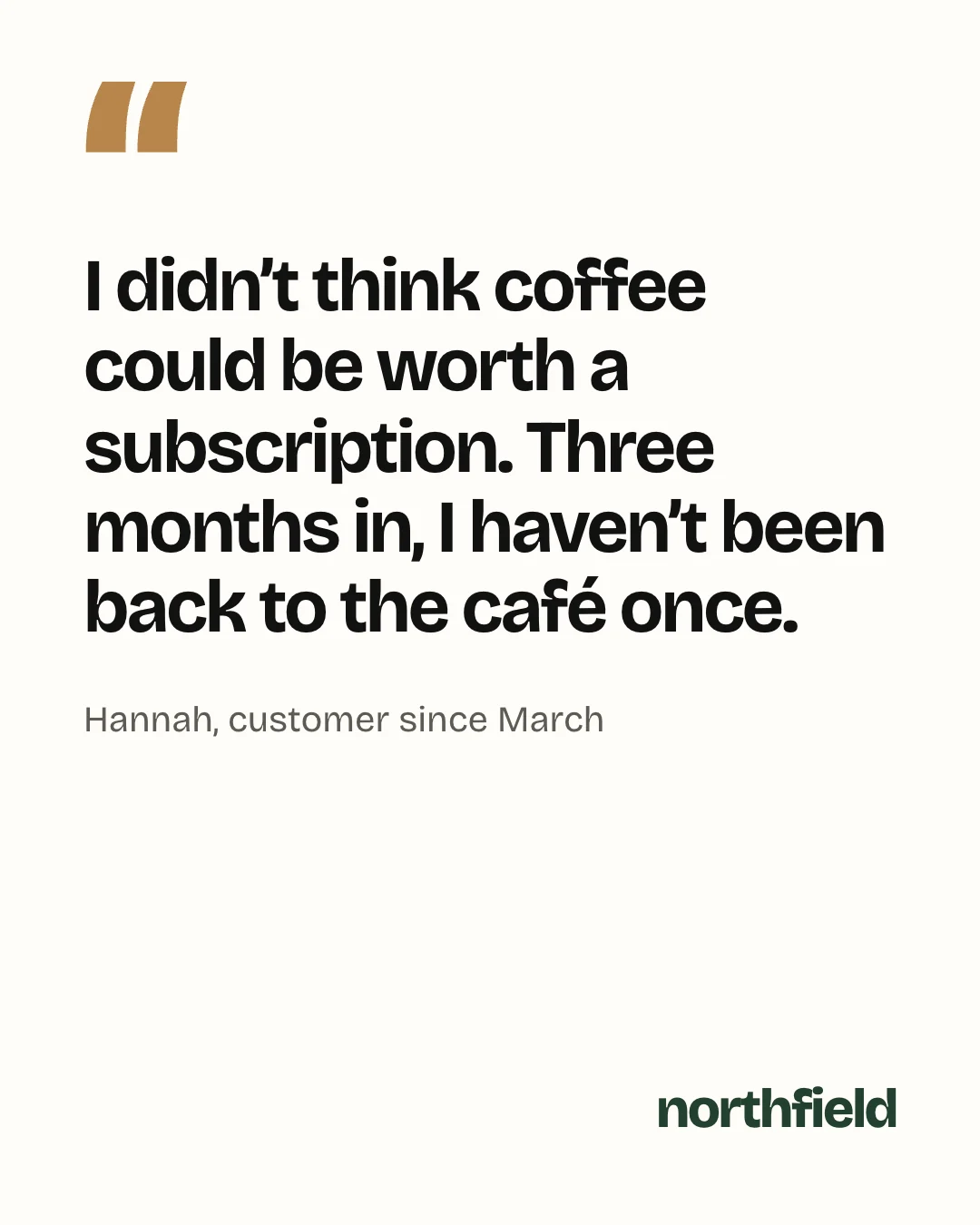
Compare “Best coffee ever!” with “Three months in, I haven’t been back to the café.” The second one has a timeframe, a behaviour change and a cost the reader can work out for themselves. It sounds like a person, not a review widget.
The details that make testimonials believable are almost always one of these: a number, a timeframe, a before, or a sensory detail. If a quote has none of them, it’s decoration.
7. The converted sceptic is the strongest story
“I didn’t think it would work, but…” beats “I love it” almost every time, because it starts where the reader is: unconvinced. It also gives you a hook and a payoff in one quote.
Showing the result helps even more. In a pet supplements account we run, a testimonial ad that showed the dog’s reaction alongside the owner’s story converted noticeably more of its clicks into orders than the account average. The owner gave the doubt and the proof. The dog gave the payoff.
8. Match the speaker to the buyer
A testimonial works best when the reader thinks “that’s me”. If most of your buyers are new parents, a quote from a new parent will beat a better-written quote from anyone else. Pick the speaker by situation first and by eloquence second.
9. The review card static
The simplest testimonial ad is still one of the most reliable: a review laid out like a review. It works because people already know how to read it, and because it looks like evidence rather than advertising.
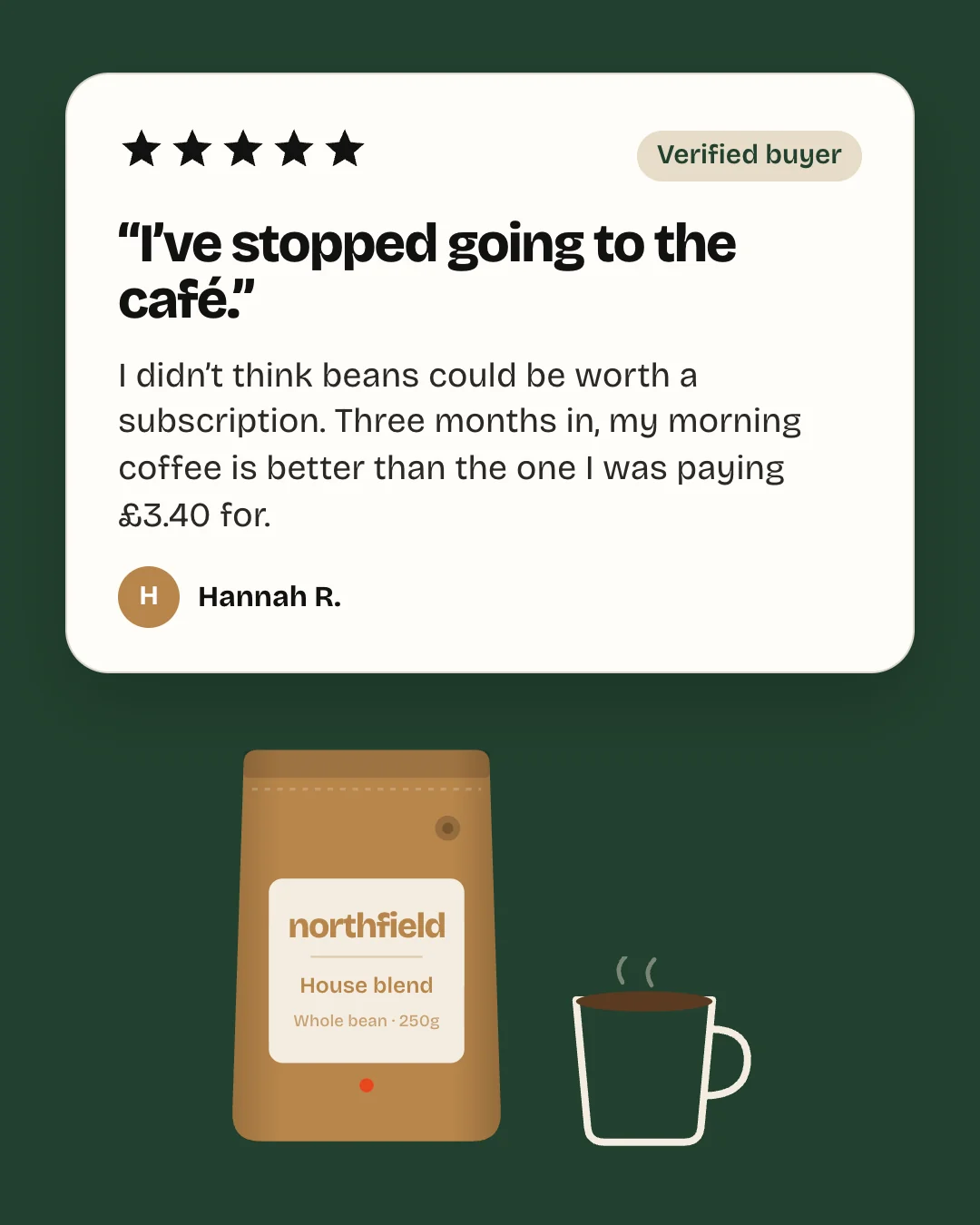
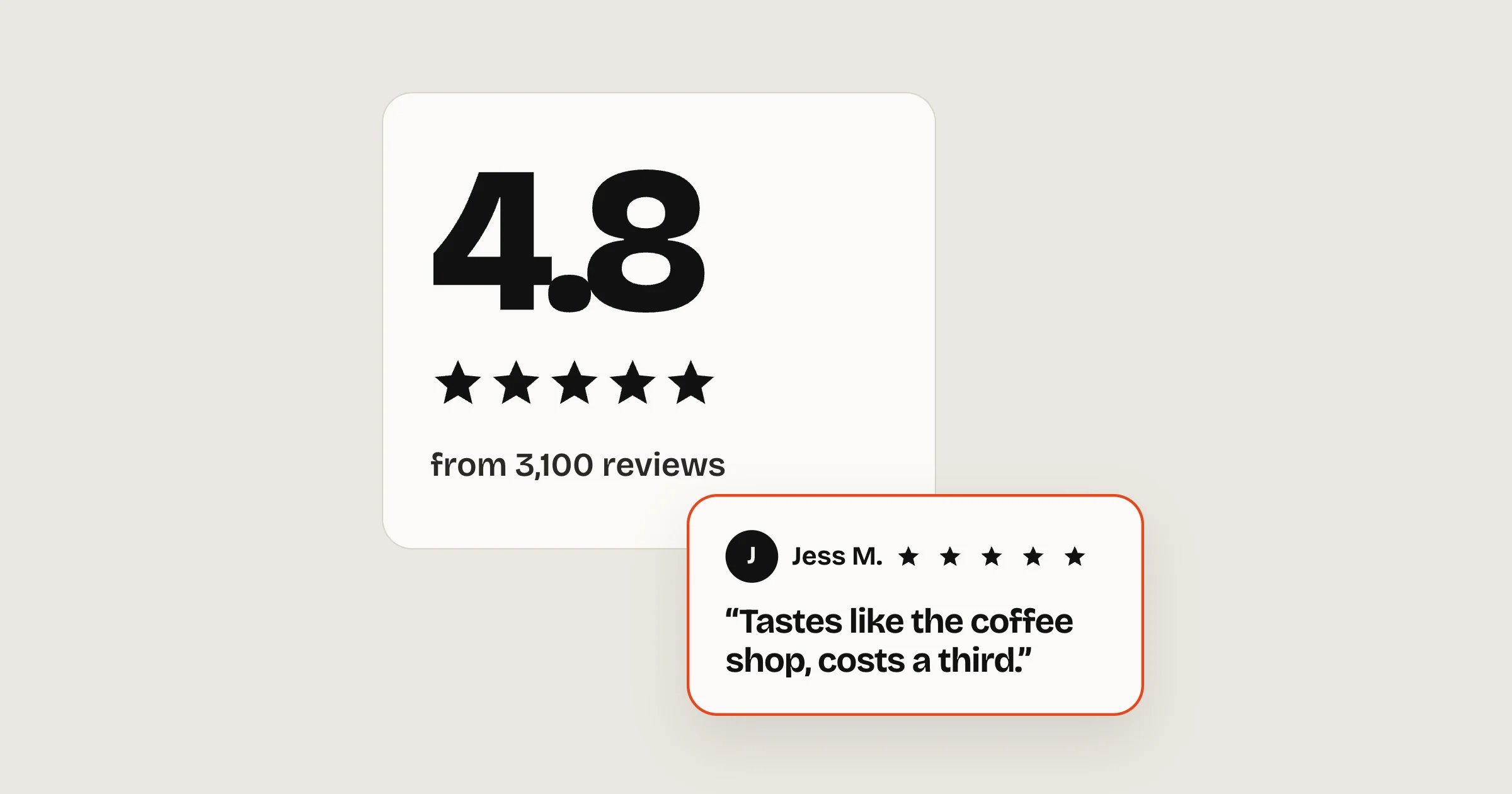
What makes one work: stars, a short title in the customer’s own words, two or three lines of detail, a first name or initial, “verified buyer” only if it’s true, and the product in shot. More layouts like this are in static ad formats.
10. Plain text can beat polished
Don’t assume a testimonial needs production. In a pet account this summer, most produced testimonial ads underperformed. The exception was plain, text-only testimonial statics: a quote, a name, nothing else. They looked like something a person would share rather than something a brand would make.
The same goes for copy. The oldest live ecom ad we found in the UK Ad Library, running since June 2023, is a short video whose entire caption is one customer’s review.
11. Video testimonials in four beats
Most testimonial videos open with an introduction. Nobody scrolling cares who Hannah is yet. Open on the doubt or the result instead, then work through four beats:
- The doubt: what they thought before they tried it.
- The before: what life looked like without it.
- The moment: when they noticed the difference.
- The result: what changed, in specifics.
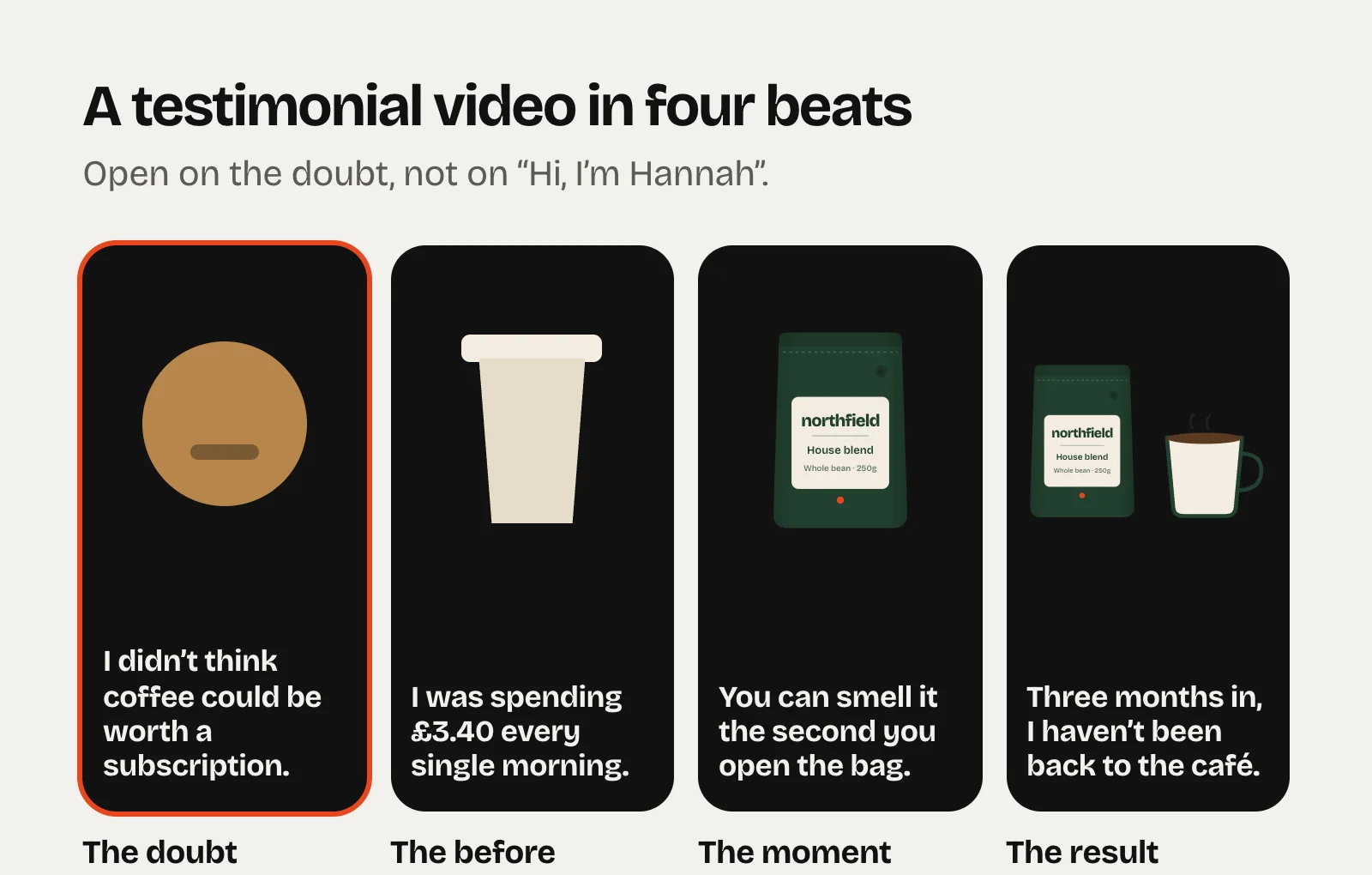
Ask the customer the four questions in that order and you’ll have the script before anyone picks up a camera.
12. Put the right one next to the button
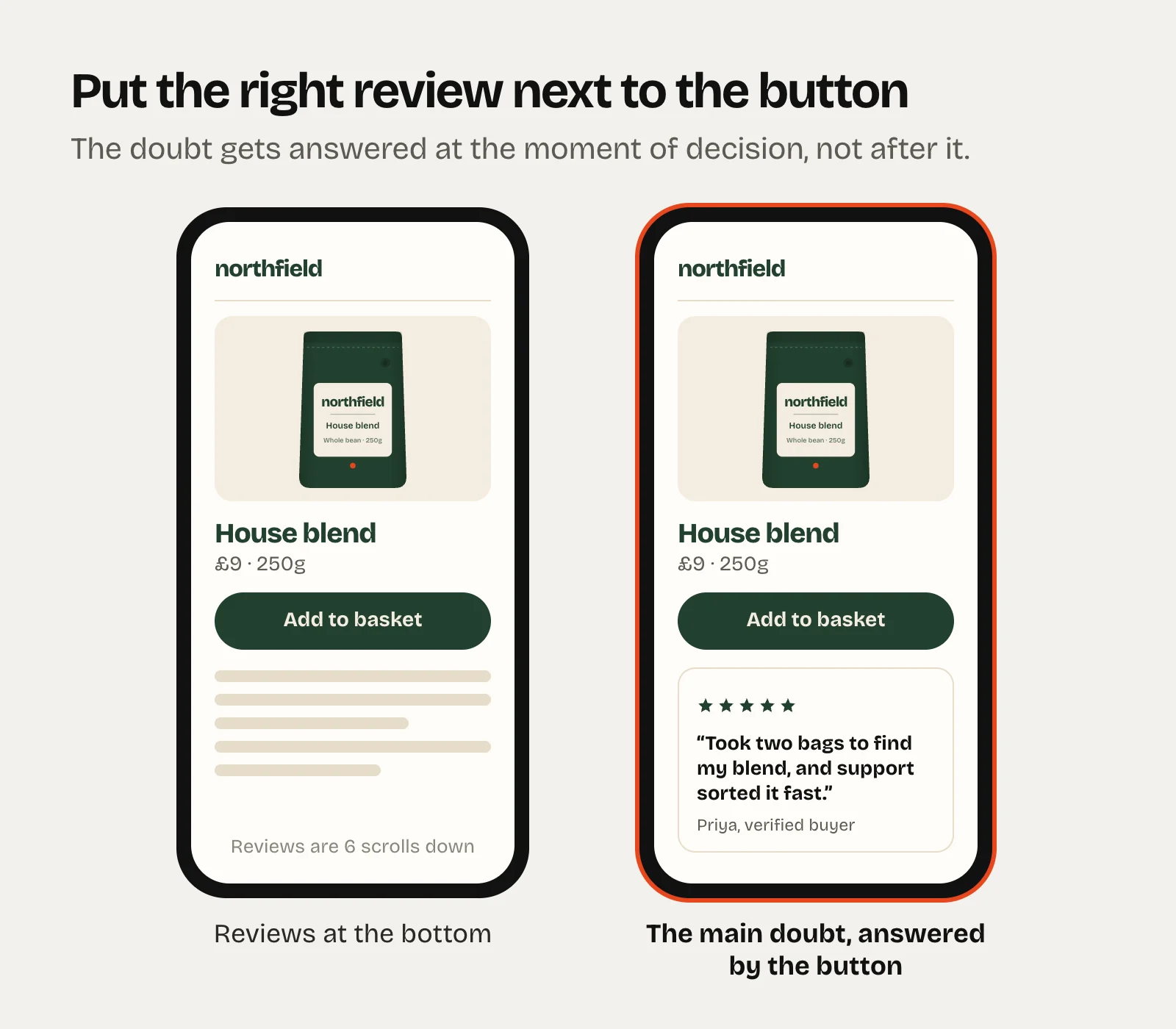
On most product pages, reviews sit at the bottom, below the description, the delivery details and the FAQ. That’s where people go to check they were right to buy, not where they decide.
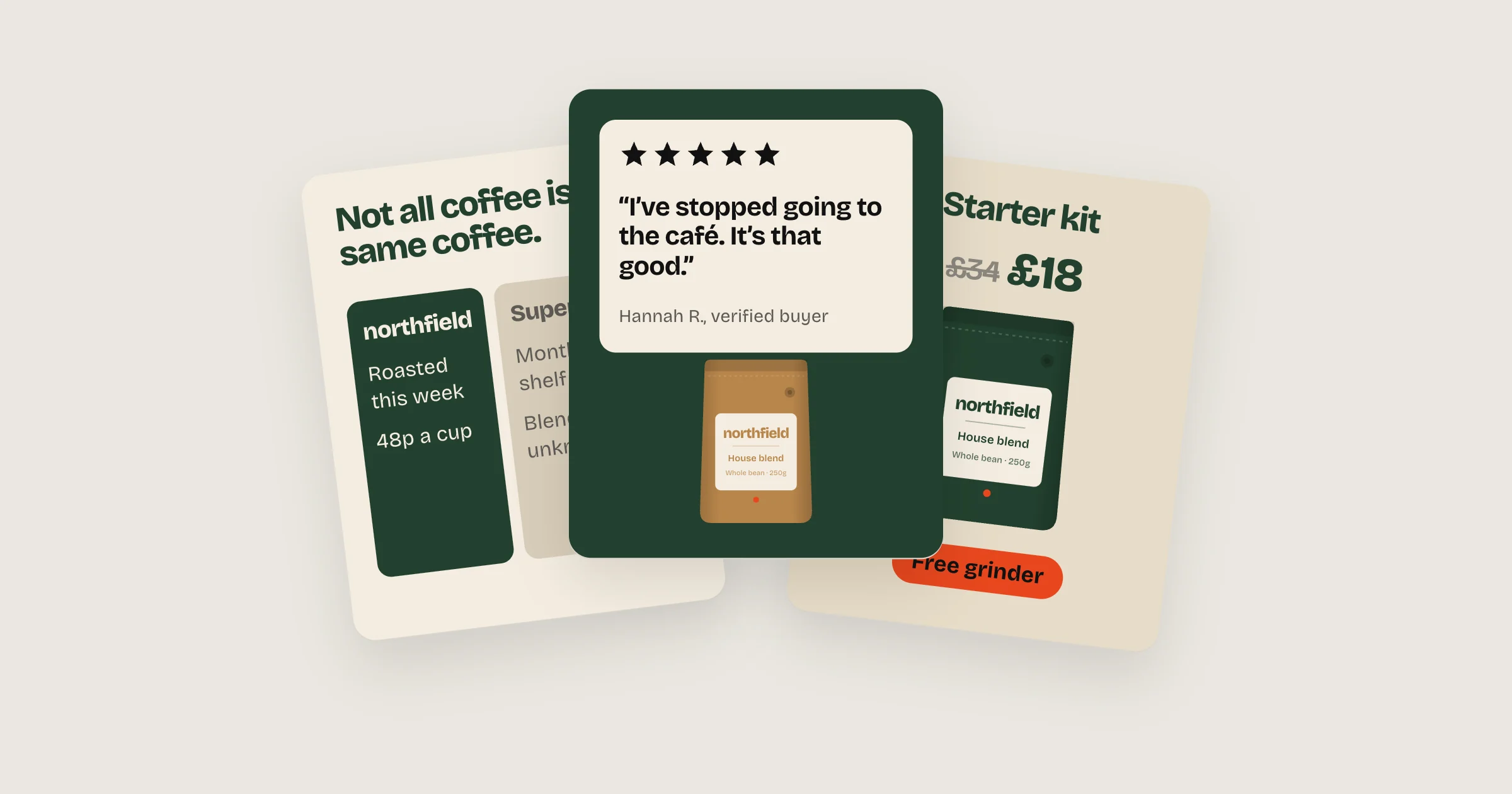
Take the testimonial that answers your biggest doubt and put it directly under the price and the add to basket button. If an ad led with a testimonial, the page should show the same one, or one that continues it.
Keep a testimonial bank
Treat testimonials like stock. Keep one sheet with every usable quote, the doubt it answers, the permission status and where it’s been used. Add ten new reviews to it every month. When you brief new ads, start from the doubt that’s costing you the most sales and pull the best quote for it.
For the wider picture of what kinds of proof move cost per purchase, read social proof in ads.